Friday, April 15, 2022

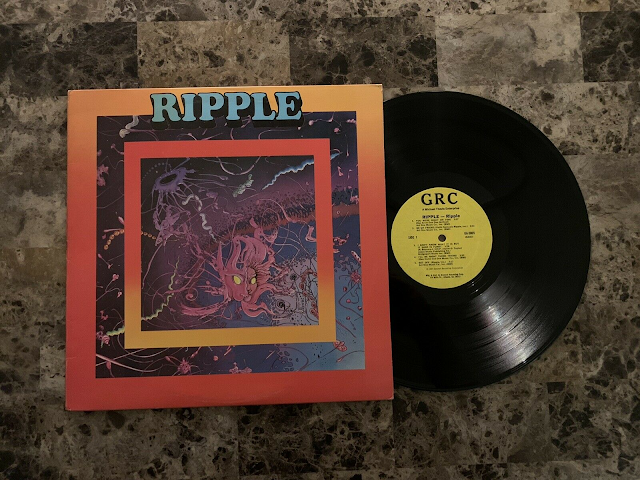
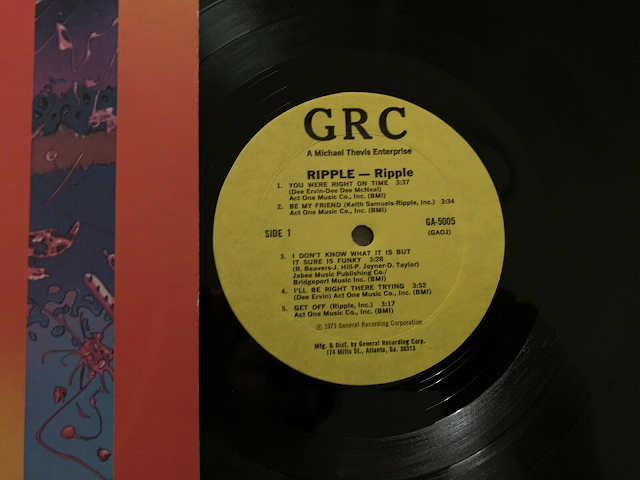
Ripple – Ripple US 1973

Ripple – Ripple

GRC – GA-5005 US 1973


Ripple was an American funk band from Kalamazoo Michigan. The group was signed to GRC Records and Salsoul Records in the 1970s, and scored several hit singles, the biggest of which were "I Don't Know What It Is, But It Sure Is Funky" and "The Beat Goes On And On," the latter on Salsoul Records, joined by the Salsoul Orchestra. After moving to Atlanta, Georgia, Wally, Kenny, and Brian restructured the group, adding Victor Burks (keyboards) and Barry Lee (guitar). The group toured extensively around the Southeast, the highlight of which was opening for George Clinton and Parliament Funkadelic on their "Mothership Connection" tour. Wally, Kenny, Brian, Victor, and Barry went on to record their seminal album, "Sons of the Gods". "The Beat Goes On And On", from that album, became a disco/hustle classic that's still being played today.

The signature "oh-la oh-la ay" line from "I Don't Know What it is, but it Sure is Funky" was later incorporated into Marcia Griffiths' smash hit, "Electric Boogie (Electric Slide)."


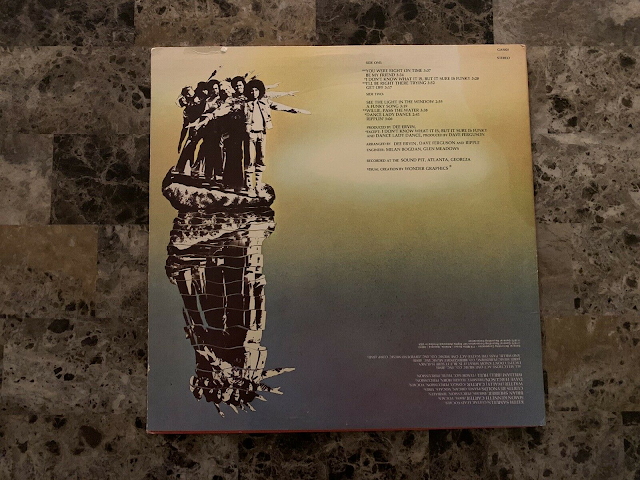
Band members

  • Keith Samuels - guitar, lead vocals
  • Simon Kenneth Carter - bass, vocals
  • Brian Sherrer - drums, percussion, timbales
  • Walter (Wally) Carter - conga, percussion, vocals
  • Dave Ferguson - trumpet, flugel horn, percussion
  • William (Bill) Hull - tenor sax, flute, percussion
  • Curtis Reynolds - organ, piano, vibe master, vibraphone, vocals
  • Victor Burks - keyboards, vocals
  • Barry Lee - guitar

Albums

  • Ripple (GRC Records, 1973)
  • Sons of the Gods (Salsoul Records, 1977)

Bio by Richie Unterberger: 

An interracial Michigan soul-funk band, Ripple had an R&B hit in 1973 with "I Don't Know What It Is but It Sure Is Funky," and made several other recordings for the GRC label in the mid-'70s. They were an eclectic hodgepodge of influences circulating in soul music at the time -- sometimes they can sound like a more pop-inclined version of Kool & the Gang, other times they sound like a less distinctive variant of Stevie Wonder. Their brand of funk was neither too raw nor too slick, with liberal pop and jazz influences. Those who like just-pre-disco funk will probably enjoy the group.

F
ULL LP:


Tuesday, April 12, 2022

Damascus Road – Damascus Road 1973

 Damascus Road – Damascus Road
Ichthus Records – IR 1002 CS US 1973

North Carolina xian folk rock LP private pressing.Mellow vibes and voices rural and soulish with progish outbursts (A5 Step Out To Sea) and a gospel style rock.
There is no sign of psychedelia or garage as it is categorised by some in order to create a hype and boost sales.

A1 Friends Medley
A2 The Tale Of The Wanderer
A3 Keep The Son In Your Eyes
A4 How Can You Tell?
A5 Step Out To Sea
B1 Walking Down The Road To Damascus
B2 Jesus, Be My Guest
B3 You Can't Take Away The Lord
B4 Thank You Jesus
B5 I Wish We'd All Been Ready

FULL LP LISTEN:

Thursday, March 24, 2022

Mandrake Memorial live footage 1967

The only live footage known to exist.Live at The Trauma/Philadelphia 1967.


Mandrake Memorial was: Randy Monaco—bass, vocals Craig Anderton—guitar, sitar, electronics Michael Kac—keyboards Kevin Lally—drums The original 1967 16mm Mandrake film from which this video was made was found by Notekillers drummer Barry Halkin in the legendary coffee house, the 2nd Fret. Halkin's father had moved his interior decorating business into the space after the venue closed in 1972. The film was then given to Mandrake superfan Mitch Paul who made the original digital transfer (and added the opening titles) years later. None of the Mandrake Memorial had ever seen ANY footage of them performing (nor did they know this footage even existed) until this past decade when social media contact was made. This footage captures them very early in their formation, and according to Kevin Lally is a nascent version of what eventually evolved into the song "Strange" from their self-titled first album. Also featured is a brief segment of Craig Anderson playing sitar and some (silent) band antics that perfectly capture the mood of the era. By David First

Monday, March 21, 2022

(Mikes) Mijal & White - I've Been You / Reflections US 1973

 (Mikes) Mijal & White - I've Been You / Reflections US 1973


Mike Mijal, class of 1968 Stevenson High School in Livonia Michigan, interned at WYNZ radio station in Ypsilanti Mi. as a board engineer and on-air personality for the Mike Lombardi show.. At 17 years old Mijal joined ATA Studios in Westland Mi. as an engineer recording and mixing for local Detroit bands in the late 60's. He also played keyboard with a popular local band called The Unveiled. Mike attended the Institute of Audio Research in New Your City and there developed his engineering skills. Mikes credentials afforded him employment at Pioneer Recording Studios in Detroit as an engineer. His reputation grew among musicians as having an audiophile's ear for recording and final mix. Still the musician, and into the new synthesizer revolution, he along with friend Michael White used spare time in the studio to write and record "I've Been You" and "Reflections". In Late 1972 Gary Rubin, owner of Pioneer Studios, thought enough of the "Mikes" music to send it through his own publishing company, Tru-Soul.


I've Been You was released in January of 1973 on the ZATOP label (Created by Mijal and White) and quickly climbed to number 3 on the local radio charts. Mijal left Pioneer to open his own recording facility in Garden City called Triple M Studios where he recorded many local, national, and international artists.

Thursday, March 17, 2022

Vytas Brenner – La Ofrenda De Vytas 1973

 Vytas Brenner – La Ofrenda De Vytas
Yare – LPY-0114 Venezuela 1973


Vytas Brenner is one of those rare gems that, despite being one of venezuelan's first progressive icons, is rarely mentioned even in his own country. He was german but never had any contact with his german roots, so he was just another venezuelan, and maybe one of the unfortunate examples that foreigners appreciate more our culture than natives.


His music is rich with images from venezuelan's culture, and applying to them the european symphonic progressive layers to develop the fusion. Rich also in instrumentation it is, from the main instruments of venezuelan folk (cuatro, harp, maracas) and incorporating electric guitars, synths, organ and symphonic instruments to complete the pack. His music also adds influences from afro-venezuelan ethnic music and latin american rhythms; examples of these rhythms may be heard in songs like "Morrocoy" and "La Sabana", with the later having extensive use of atmospherics and percusions, while the former also includes "joropo" rhytms from venezuelan plains, which is also featured in "La Ofrenda de Miguel", with it's blues flavoured bridge; "Canto del Pilon" in a more symphonic surrounding and a drum solo spot; and, in a more pure form in "La Tormenta de Barlovento". "Frailejon" seems to borrow more from western culture. "Tragavenado" and "Araguaney" could be seen as one song, with a certain margaritean feel to them; the latter features the best piano display from Vytas.
Vytas did not only portrayed the venezuelan tradition in the music, but the song titles make references to national symbols from flora, fauna and geography. A well crafted, well produced and well executed album, which, and whilst borrowing from the symphonic movement, sounds nothing like Genesis, Yes or other brittish progressive pillars; it is a pillar on it's own which, unfortunately, made less influence than it's contemporaries. It also fails to be pompous or overblown, making it a light listening experience.
A masterpiece of Venezuelan Symphonic Folk music.


Vytas Brenner (born 19 September 1946, Tübingen, Germany – died 18 March 2004, Salzburg, Austria) was a Venezuelan guitar and keyboard player.

His family migrated to Venezuela in 1949. His mother, Margarita Brenner, was an opera singer. In 1959, his family went to Italy and later to Spain where he founded a folk band: "Vytas Brenner Quartet", with his brother Haakon Brenner (bass), Jordi Sabates (drums, also a sound engineer) and Toti Soler (rhythm guitar). Later Jeanette Dimech joined them and they re-named as Brenner's Folk (and later Pic-Nic) before moving to Venezuela. They released and EP but soon after the Brenner brothers returned to Venezuela, where Vytas started a solo career. At 21 years old, Vytas moved to Tennessee, USA to study at the University of Tennessee's Music Conservatory, where he was a pupil of David Van Vactor. Later, at college in Nashville, Vytas took post-graduate courses in Electronic music with Professor Gilbert Trythall, and graduated with honors in 1972. In 1971 he started a duo named "Vitas & Mafe" with Venezuelan singer María Fernanda Márquez. In 1972 Brenner formed his own band, "La Ofrenda" (= The Offering) and recorded 5 very successful LP's until 1979. With "Ofrenda" he started his pioneer work with compositions for combinations of electric and electronic instruments (synthesizers) with acoustic instruments and piano; and blending Progressive-Symphonic Rock, Latin rhythms, and Venezuelan traditional themes, with astounding results. In 1982 a somewhat reunited "Ofrenda" performed at the "Teatro de Bellas Artes de Maracaibo", but was coldly received by the public. In 1989 the Venezuela Symphony Orchestra performed his work "Oro Negro" ("Black Gold") at the Caracas' famed Teatro Teresa Carreño. In 1989 he released the CD album entitled "Amazonia". He was commissioned to compose works for "Viajando con Polar", a series of short documentaries about Venezuela's regions. He created music for various films, such as "Adiós Alicia", "Se llamaba SN", and Román Chalbaud's "Carmen la que contaba 16 años". All the while, Brenner was a very successful studio musician, composing and performing in countless radio jingles, TV commercials and presidential campaigns.

Brenner died 18 March 2004 of a heart attack in Salzburg, Austria at the age of 57, while recording music for an upcoming CD. 

FULL LP: